Today I went back flying for the first time since my break. Man oh man did it feel good. This must be how guys in the Army feel when they come back from tour and see their wives/gf. Except in this case my wife was in the plane with me, and I was coming back to the plane....
Nevertheless it was a breezy day. Winds variable from 270-310 8kts gusting to 14kts. Not a terrible day, but a nice fun crosswind to challenge me. I flew to the practice area and did a few turns, then flew to Indy Executive and did a touch and go. It was really bumpy and I had trouble getting my side slip the way I wanted. I came in fast and floated what felt like half of the runway, touched my wheels and firewalled the throttle.
My next go around I came in over the numbers at 55-60kts and kissed the runway perfectly. The left main rolled gracefully, followed by the right main firmly, and the confirming nod of the nose wheel. Text book. My excitement was short lived as I had a plane on final behind me. Once again, I gave her full throttle and departed to head back to Eagle Creek.
It must have been a pretty busy day today at EYE. About 6 miles out I heard the Comm Frequency full of chatter. One plane was departing, another departing the pattern west, and another inbound. I quickly made a mental picture of what was going on around me and tried to identify where everyone was. I had the departing traffic in sight, but I needed to find the traffic heading westbound. I called out "Eagle Creek, Departing Traffic what's your location". No response. "Eagle Creek Traffic Departing Traffic what's your altitude?". "Cessna XXX, I am 1800 and just west of EYE." By this time I was at the North end of the lake at 1800ft! "Eagle Creek 70PF will circle until west bound traffic has departed the pattern".
By this time the departing traffic was now airborne. "I caught him at my 12 o'clock as I finished making my circle. In ground school you are taught that if you see an aircraft and it's not moving and only getting bigger, then you are on a collision path. Well this plane wasn't moving and getting bigger. I let him depart the pattern, I entered my downwind and made my third and final crosswind landing of the day.
I love aviation so much. It challenges me in every way possible. I will probably get back up a few more times before October as I will be due for my first Bi-Annual Flight Review. I want to make sure my skills are sharp and I'm ready to go.
Sunday, September 23, 2012


Tuesday, August 28, 2012
The Reality of the Economy
To all my loyal readers and subscribers I'd like to thank you for reading my blogs. I bet you are wondering why haven't we heard from Captain K?
Well the answer is easy. Gas Prices. Most piston driven general aviation airplanes run off of what is called avGas. This is similar to the gasoline ran in your car except for one well known ingredient, Lead. AvGas is 100 octane leaded fuel. The lead helps reduce engine knocking and helps achieve the high octane rating.
When I first started flying back in 2009 gas was $3.49 per gallon. At that time it wasn't much higher than automotive gas. Well as you know the tides have changed. Automotive gas now soars above that with prices averaging around $3.99 a gallon at my local station. My home airport Eagle Creek EYE has AvGas priced at $5.80 a gallon.
The days of just waking up in the morning and punching holes in the sky are starting to fade away. Now the reality of "what is my mission" is the question I now ask. As I do pleasure flights, I must make sure that they are also benefiting my future ratings as well as currency requirements.
Aviation is still fun and something I pray is always a part of my life. But unfortunately until gas prices come back down, I'll spend more time on the ground.
Well the answer is easy. Gas Prices. Most piston driven general aviation airplanes run off of what is called avGas. This is similar to the gasoline ran in your car except for one well known ingredient, Lead. AvGas is 100 octane leaded fuel. The lead helps reduce engine knocking and helps achieve the high octane rating.
When I first started flying back in 2009 gas was $3.49 per gallon. At that time it wasn't much higher than automotive gas. Well as you know the tides have changed. Automotive gas now soars above that with prices averaging around $3.99 a gallon at my local station. My home airport Eagle Creek EYE has AvGas priced at $5.80 a gallon.
The days of just waking up in the morning and punching holes in the sky are starting to fade away. Now the reality of "what is my mission" is the question I now ask. As I do pleasure flights, I must make sure that they are also benefiting my future ratings as well as currency requirements.
Aviation is still fun and something I pray is always a part of my life. But unfortunately until gas prices come back down, I'll spend more time on the ground.
Monday, June 18, 2012
HOT HOT HOT
Today's fun fact is density altitude. Density altitude to most new pilots is the most CONFUSING thing to learn about in aviation.
For the sake of the keeping things simple (Which is my model) the hotter it is outside, typically the higher the density altitude. The higher the density altitude the more of a DECREASE in aircraft performance you will find.
A perfect example of this is a stock 2011 ford mustang gt with drag slicks could run a 12.5 second quarter mile in Denver Colorado on a hot summer day. That same exact car, could run a 11.2 second quarter mile on a cool spring day at sea level.
Density altitude is HUGE in aviation. In effects how much runway you need, your climb performance, your landing roll, and even how much fuel you burn. Density altitude for lack of a better description is the altitude the aircraft feels like it's at. An example is the field elevation at my home airport of EYE. It is around 800 feet. However today the temperature is 32 degrees Celsius, with a barometric temperature of 29.88inches which gives us a density altitude of about 3,000feet.
Here's a simple chart that's used to calculate it.

So next time you hop in your car on a hot day and you ask yourself "Man why does my car feel sluggish", you can now respond "Density Altitude".
For the sake of the keeping things simple (Which is my model) the hotter it is outside, typically the higher the density altitude. The higher the density altitude the more of a DECREASE in aircraft performance you will find.
A perfect example of this is a stock 2011 ford mustang gt with drag slicks could run a 12.5 second quarter mile in Denver Colorado on a hot summer day. That same exact car, could run a 11.2 second quarter mile on a cool spring day at sea level.
Density altitude is HUGE in aviation. In effects how much runway you need, your climb performance, your landing roll, and even how much fuel you burn. Density altitude for lack of a better description is the altitude the aircraft feels like it's at. An example is the field elevation at my home airport of EYE. It is around 800 feet. However today the temperature is 32 degrees Celsius, with a barometric temperature of 29.88inches which gives us a density altitude of about 3,000feet.
Here's a simple chart that's used to calculate it.

Sunday, March 25, 2012
Cloud Time
Yesterday I logged some cloud time. I must admit it was pretty cool. My CFII called up Indy Approach and grabbed a pop up clearance. Indy gave us a squawk code and cleared us up to 4,000 feet.
Once we entered the clouds it was a very different feeling. Throughout my entire life as a pilot I have been trained to AVOID the clouds. Remain 500 feet below them or 1,000 feet above them. Now we are purposely going in the clouds. I have to tell you it is the strangest feeling ever.
Once I entered the clouds I was engulfed in whiteness. The best way to describe it to non pilots is imagine being in your car with a white sheet being placed over your windshield and you are traveling 130 mph while 3,000 feet above the ground.
Reality hit that I'm no longer in a scrimmage game. I'm in the real deal. I'm flying under REAL Instrument Flight Rules, under REAL instrument conditions. Instinctively I buried my head even further down into the instruments performing my scan.
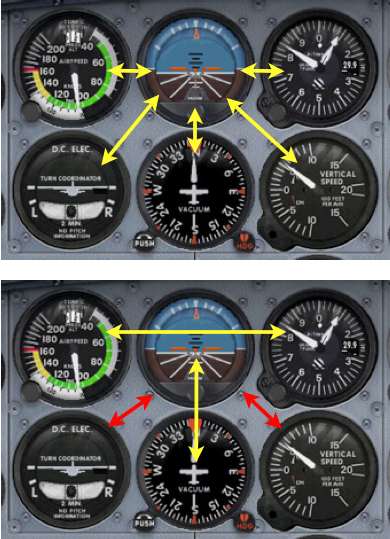
This is important because while in the clouds I began to get the leans. What this means is I felt as if I was turning and climbing, when I was actually flying straight and level. If I didn't trust my instruments I would have corrected for the turn that didn't really exist, thus putting the plane into a turning descent.
Flying under IFR is serious business and I was reminded again why pilots say this is one of the HARDEST rating to get.
There were pockets of flying when I would briefly pop out of the clouds and be able to see the sky above me. It is absolutely the prettiest thing in the world. It almost makes you feel as if you are touching the hands of God. You look below and you see fluffy cotton candy, above you blue sky shielded by wispy cirrus and stratus clouds and the flicker of sunshine. We were then interrupted by Indy Approach. "Zero-Papa-Foxtrot, traffic 5 miles, 3 o'clock level at 5,000, Heavy - DC-10". My CFII replied "Looking for traffic 0PF". We entered another cloud, and popped up and sure enough a FedEx DC-10 was flying over head us. I really wanted to take a picture, but it was getting bumpy so my hands were a bit busy.
We then asked to return to EYE and got vectors from ATC to shoot the localizer 21 approach at Eagle Creek. I shot the approach, landed, refueled, and put the plane away safely in the hangar.
Wednesday, March 14, 2012
Instrument Training and IFR Flying 101
Well since March began I have hit my instrument flight training pretty hard. I'm somewhere at about 10 hours or so into it and I can tell you that it is CHALLENGING!! This is honestly one of the hardest things I've done in aviation. I remember back when I first started learning how to fly that landing was the hardest. Now it's tackling these advanced maneuvers and procedures.
I've touched on this before in previous post but I'll try to summarize things again. There are two types of flying "rules". These rules are Visual Flight Rules 'VFR' and Instrument Flight Rules 'IFR'. The rules vary depending on your altitudes and airspace, but for the purpose of the blog VFR minimums are 3 statute miles of visibility, and 1,000 foot ceilings. IFR flying minimums are essentially 0 ceiling and 0 visibility. However to land using an Instrument Landing System you need 200 foot ceilings and 1/2 mile visibility. (Pilots, remember this blog is geared towards non pilots, so I know these minimums vary and depends on a ton of factors).
Currently I am a non instrument rated pilot. Which means I can only legally fly under VFR rules. In essence VFR flying requires me to have my head outside the window and using the see and avoid method to avoid obstacles, and visual methods to navigate. This is similar to driving a car, you look outside to see where you are going while occasionally glancing at your speedometer, gps, or whatever gizmo you have in your car.
Instrument flying is the complete opposite. Since you cannot see outside and have no visual references since you are in the clouds; you are relying on the aircraft's instruments to maintain proper attitude, and to navigate.
Flying a plane under real IFR conditions by hand without the use of an autopilot is the equivalent to driving in a construction zone, while eating dinner, changing radio stations, while its raining, speeding, and talking on the cell phone to that person you really don't feel like talking to but you've hit ignore too many times before. Oh yeah, and don't forget the mental math you must be doing, so let's equate that to balancing your checkbook. Now doing any one of these task by hand is really simple and not difficult at all, but doing them all at once is a balancing act which is very challenging and mentally tiring.
My lessons are anywhere between 1 - 1.5hrs long and I can tell you I'm BEAT afterwards. I can fly VFR for about 3 hrs before I get tired and need to stretch my legs.
Navigating under IFR is done just like it was back in WWII. There are 'fixes' or navigational aids located on the ground. These navigational aids are all radio based and basically send out signals. These signals are then picked up by equipment in the airplane to tell you how far you are from the fix, and what radial or angle you are in relationship to the fix.


This is a visual depiction of what a radial is and how a plane fly's on it. As you can see the top planes are flying to and from the station, while the plane at the bottom is transitioning the area and using the VOR to determine it's location relative to the station.
 The instrument above is the primary navigation receiver called an Omni Bearing Selector OBS. The numbers on the outside can be rotated with the OBS knob to select what radial you are tuned to. Then the needle points to tell you if you are tracking from the station or to the station.
 This last picture shows an OBS which is tuned to the 360 radial. If the pilot the plane on the 360 radial the needle will swing and line up like the picture above. The key is for the pilo flys t to keep the needle lined up on the radial he/she wants to fly on.
I've touched on this before in previous post but I'll try to summarize things again. There are two types of flying "rules". These rules are Visual Flight Rules 'VFR' and Instrument Flight Rules 'IFR'. The rules vary depending on your altitudes and airspace, but for the purpose of the blog VFR minimums are 3 statute miles of visibility, and 1,000 foot ceilings. IFR flying minimums are essentially 0 ceiling and 0 visibility. However to land using an Instrument Landing System you need 200 foot ceilings and 1/2 mile visibility. (Pilots, remember this blog is geared towards non pilots, so I know these minimums vary and depends on a ton of factors).
Currently I am a non instrument rated pilot. Which means I can only legally fly under VFR rules. In essence VFR flying requires me to have my head outside the window and using the see and avoid method to avoid obstacles, and visual methods to navigate. This is similar to driving a car, you look outside to see where you are going while occasionally glancing at your speedometer, gps, or whatever gizmo you have in your car.
Instrument flying is the complete opposite. Since you cannot see outside and have no visual references since you are in the clouds; you are relying on the aircraft's instruments to maintain proper attitude, and to navigate.
Flying a plane under real IFR conditions by hand without the use of an autopilot is the equivalent to driving in a construction zone, while eating dinner, changing radio stations, while its raining, speeding, and talking on the cell phone to that person you really don't feel like talking to but you've hit ignore too many times before. Oh yeah, and don't forget the mental math you must be doing, so let's equate that to balancing your checkbook. Now doing any one of these task by hand is really simple and not difficult at all, but doing them all at once is a balancing act which is very challenging and mentally tiring.
My lessons are anywhere between 1 - 1.5hrs long and I can tell you I'm BEAT afterwards. I can fly VFR for about 3 hrs before I get tired and need to stretch my legs.
Navigating under IFR is done just like it was back in WWII. There are 'fixes' or navigational aids located on the ground. These navigational aids are all radio based and basically send out signals. These signals are then picked up by equipment in the airplane to tell you how far you are from the fix, and what radial or angle you are in relationship to the fix.

This is a VOR receiver. VOR's transmits radials in 360 degrees out from the station. My plane's VOR receiver then can be tuned to the radial and I can fly either to the station or from the station. These stations are interconnected throughout the country to form what are called airways. Ever wonder why you always hear planes flying over head? Maybe more so during cloudy days? It's possible you have an airway over your home. These airways are crucial for not only general aviation, but commercial travel.

This is a visual depiction of what a radial is and how a plane fly's on it. As you can see the top planes are flying to and from the station, while the plane at the bottom is transitioning the area and using the VOR to determine it's location relative to the station.
Sunday, February 26, 2012
Currency Renewal
As I look through my log book I realize its time for me to renew my night currency. FAR 61.57 Recent Flight Experience states that "no person may act as a pilot in command of an aircraft carrying passengers or of an aircraft certificated for more than one pilot flight crew member unless that person has made at least 3 takeoffs and three landings withing the preceding 90 days".
Specifically for night experience "No person may act as pilot in command of an aircraft carrying passengers during the period beginning 1 hour after sunset and ending 1 hour before sunrise, unless within the preceding 90 days that person has made at least three takeoffs and three landings to a full stop during the period beginning 1 hour after sunset and ending 1 hour before sunrise."
So basically what that means is tonight I'm going flying!!! This will be kind of a boring flight, but it will give me a chance to focus on some basic fundamentals and pattern work. I'm a firm believer that solid fundamentals make for solid performance of advance maneuvers.
Specifically for night experience "No person may act as pilot in command of an aircraft carrying passengers during the period beginning 1 hour after sunset and ending 1 hour before sunrise, unless within the preceding 90 days that person has made at least three takeoffs and three landings to a full stop during the period beginning 1 hour after sunset and ending 1 hour before sunrise."
So basically what that means is tonight I'm going flying!!! This will be kind of a boring flight, but it will give me a chance to focus on some basic fundamentals and pattern work. I'm a firm believer that solid fundamentals make for solid performance of advance maneuvers.
Saturday, November 5, 2011
Why We Fly
As we dig deeper into fall and winter approaches, aviation changes like usual. A few month's ago I wrote a post about how aviation changes in the dog days of summer. Well now the tide reverses and things switch and you get the complete 180 of the pro's of summer flying and the cons of winter flying. I guess fall would give you a 90 degree switch and you would get the best of both worlds???
As always I'll try to stay very high level as this topic can get so deep that people literally get advanced degrees on this topic. I don't have a PhD in this topic, and chances are you don't either so let's keep it simple for everyone's sake.
When it gets cold outside the performance of the aircraft increases, the engine runs better, and the air is smoother and has less turbulence. It's not a coincident that this is most pilot's favorite time of the year to fly. However a recent article by the Aircraft Owners and Pilots and Association (AOPA) reminds myself and other pilots of the hazards of flying this time of year. I don't want to go in details because the purpose of this blog is to share my experiences of general aviation, and inspire others to learn to fly. If I discuss the hazards it might frighten people away.
However, this is the time of year when I not only got my ticket, but I first soloed. I think because of these important dates of my life, I will forever hold a special place in my heart for fall and winter flying. The reason I fly is because of my love for aviation. Every single time I rotate at 55kts, and my wheels slowly rise from the earth at 60-65kts I am truly a student again. I have an addictive thirst for knowledge. The weather is always different, the traffic in the pattern is always changing, ATC is always telling you to do something different, and the list goes on.
Any pilot who says they don't learn something on each flight should probably hang up their headsets because they have lost the Joy of Flying....
Thank you for your support and I hope to post some awesome pictures soon. Did I mention that pictures even come out better in the winter time?? If you don't believe me, google it!
Saturday, October 29, 2011
David Clark ANR Upgrade Install and Review
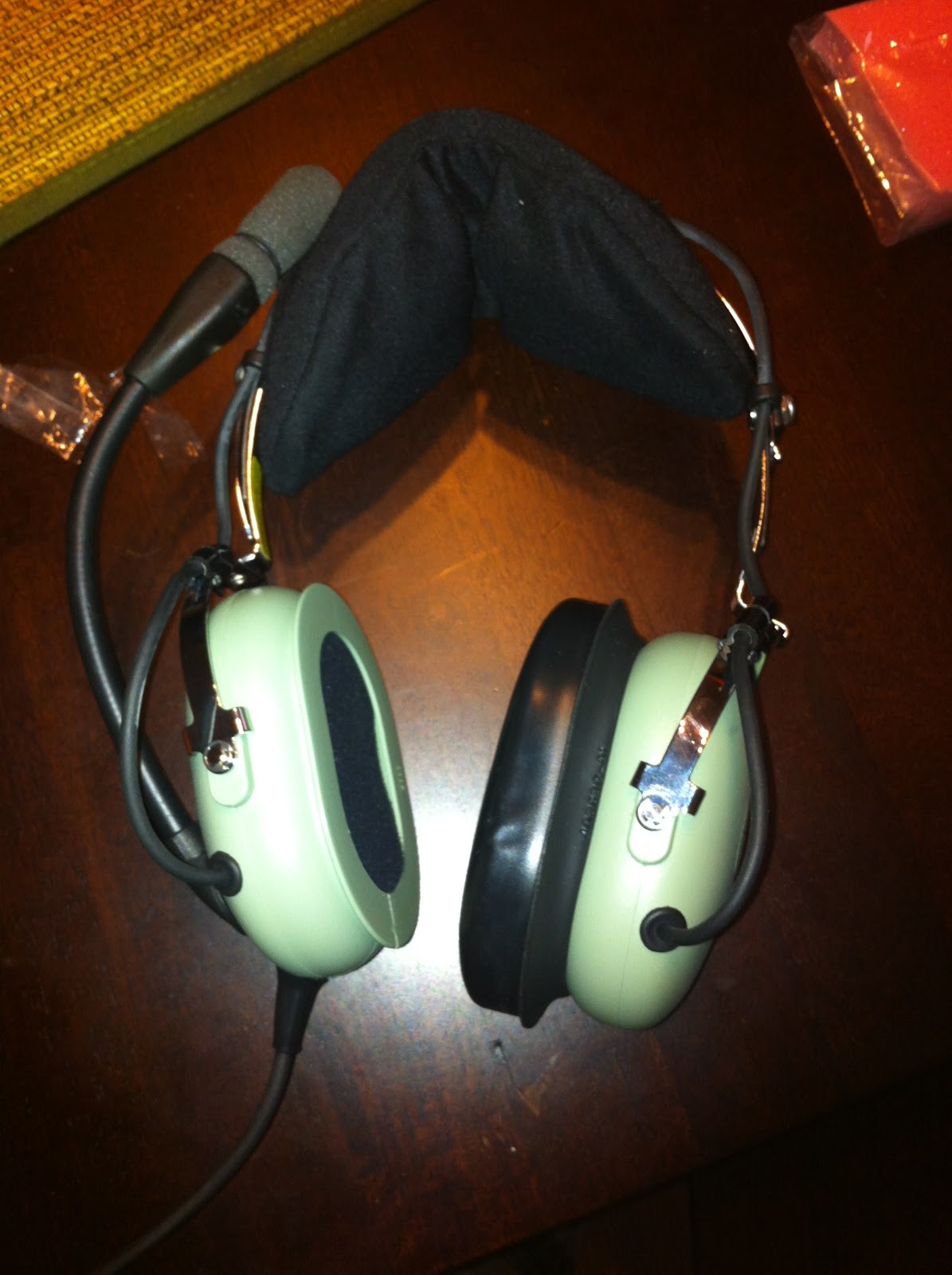
Yesterday I installed an Active Noise Reduction Kit (ANR) to my David Clark H10-13.4 headsets. David Clark is the number seller of passive style headsets. These are the green headsets you see in almost any movie/tv show with an airplane or helicopter. These headsets are build tough. As a matter of fact, so tough that many pilots still own the first pair of David Clark headsets that they purchased many years ago.
Since many of my readers are not pilots, I want to give you a quick background on what headsets are, how they work, and why they are important.
Headsets are devices that aid a pilot in doing 3 things. Provide ear protection from wind and engine noise, listen to the radios, communicate on the radio. There are two main types of headsets, Passive and Active. Passive style headsets work by muffling the sound with sound absorption materials. Active headsets use noise canceling technology to block out the unwanted sounds. Passive Headsets have been around the longest and since they are simple in design, cost the least. That being the case, this is what most pilots start off with including myself.
Bose and Zulu are two of the most popular makers of ANR Headsets. They are extremely expensive ranging from $700 - $1,200. A company called Headsets Inc. actually makes a kit to convert your passive David Clark headsets to ANR headsets. I was very skeptical at first, however after doing research I couldn't find one bad review on the product.
The product comes in two flavors, self install or factory install. Along with that there are a host of other upgrades such as auto battery shutoff, upgraded cabling etc. Me being me, and one who likes to save money, I chose the self install option, the auto battery off upgrade, and the upgraded cabling. I detailed the installation below.
The kit comes with everything in the picture below.

Temperfoam insulation, 3-in-one cable, new crossover cable, battery box, anr modules, and some instructions and wiring diagrams.
The first step is to remove your existing ear seals. The kit requires either gel ear seals in a new or like new condition. Foam ear seals will not work as they do not provide a proper seal. If you are installing these on an old headset you may want to consider this a good time to replace those old worn out foam earseals with new gel seals.


Once the speaker cover is removed you will see some acoustical foam. Remove that foam to reveal two screws that hold the speaker to the ear cup. Remove those 2 screws to remove the speaker.


It's a good idea to find a dvd case to use a spreader to give you some room to work with. Cut your existing jack cables, and crossover cables. I chose to leave as much wire as possible to give me more room to work with.

Install the new crossover cable, and new jack cables. Use the zip tie to keep the jack cables from slipping out. If you look closely at the picture you will see it. The next step is to solder your connections per the wiring diagram. If you don't have experience soldering get some old speaker wire and practice. It's pretty easy once you get the hang at it.

Trim the wire tie back neatly.

As you continue to solder don't forget to put the wire wrap on first. Oops, I made that mistake a few times. It's no big deal though, just simply undo your solder and try again. Use a cigarette lighter to get the shrink wrap to shrink.

Now is the time to install the final connections. You must connect the new wires to the new ANR Circuit boards. This is something that if you have never done before, I recommend taking a few lessons on youtube on. It's still a simple process, but certain techniques must be followed to prevent you from burning up your brand new $160 silicon wafer. The trick is to make sure you tin your wires first, and get a fat bead of solder on the circuit. Just be careful that you don't burn a whole in it, or touch another tracing and you should be just fine.

Finally apply the double sided tape, install the original insulation that fits in the deepest portion of the cup, then install the new pink temperfoam.

Take note of which cup you want to be your left, and which cup you want to be your right. Each cup is marked and it's important for the microphone positioning that are inside your cup. This is the only downside if you like to switch which side is your left or right often. So make sure you decide before you begin installation.
VOILA!!! You are all done!!!!

This mod sounds AMAZING. I tested them out this morning for breakfast. I decided to fly to 4I7 (Greencastle/Putnam County). They have a $5.99 all you can eat breakfast buffet. Yummy. The ANR makes a world of a difference. I wonder how I flew before I had these. God willing, I will never fly without ANR again. For anyone who is on the fence about getting this kit, GET IT!!! If you have basic wiring skills, or have installed a car radio before, save yourself the $50 and install it yourself. If not the folks at Headsets Inc. will install your ANR for you.
Tuesday, October 11, 2011
Richmond Indiana RID
I flew a buddy of mine this past weekend and he recorded some cool clips. I've posted it above. This is what General Aviation is all about!
Wednesday, September 14, 2011
Dog Days of Summer
Being born and raised in Atlanta, I can take the heat with the best of them. I've been out in the sun every summer since I was 2 years old. But I tell you what this summer has been a straight dog. I'm not complaining don't get me wrong, because I'll take this over snow and ice ANYDAY.
But inside of a Piper Warrior with 90% humidity, calm winds, and 95 plus degree heat....You might as well be in a sauna. My flights lately have been night flights to beat the heat. However I have had a few pretty cool flights so far this summer. I flew down to Sikeston , Missouri. It's not too far north of Memphis right where the ohio river joins the mississippi.
For this flight I had the pleasure of being co-pilot for a buddy in his Piper Aztec. This is a twin engine piston engine plane. It has retractable gear and a constant speed prop. It's a pretty nice bird. It can hold 6 people and there luggage and still carry a good amount of fuel. The only bad thing I can say about the plane is that it likes to fly low (Under 8k Feet) and isn't as fast as a Baron or other typical twin engine planes you normally see. But it'll get you there still a heck of a lot faster than a car, and is definitely more fun.
Here are some pictures below of my flight. At the time of the flight Southern Missouri was recovering from the major flooding that they were having. You could actually see many of the fields that were destroyed.
But inside of a Piper Warrior with 90% humidity, calm winds, and 95 plus degree heat....You might as well be in a sauna. My flights lately have been night flights to beat the heat. However I have had a few pretty cool flights so far this summer. I flew down to Sikeston , Missouri. It's not too far north of Memphis right where the ohio river joins the mississippi.
For this flight I had the pleasure of being co-pilot for a buddy in his Piper Aztec. This is a twin engine piston engine plane. It has retractable gear and a constant speed prop. It's a pretty nice bird. It can hold 6 people and there luggage and still carry a good amount of fuel. The only bad thing I can say about the plane is that it likes to fly low (Under 8k Feet) and isn't as fast as a Baron or other typical twin engine planes you normally see. But it'll get you there still a heck of a lot faster than a car, and is definitely more fun.
Here are some pictures below of my flight. At the time of the flight Southern Missouri was recovering from the major flooding that they were having. You could actually see many of the fields that were destroyed.
Tuesday, March 29, 2011
Instrument landing clips
The first clip is a low hanging overcast that's VFR on top.
http://www.youtube.com/watch?v=a1hFE1BOB0Y&feature=youtube_gdata_player
This clip is a raining day
http://www.youtube.com/watch?v=SacFRH_H6gg&feature=youtube_gdata_player
http://www.youtube.com/watch?v=a1hFE1BOB0Y&feature=youtube_gdata_player
This clip is a raining day
http://www.youtube.com/watch?v=SacFRH_H6gg&feature=youtube_gdata_player
Fun time is over
Is been almost 16 months since my first solo flight back in December 2009. That was the happiest moment of my aviation life. No matter how far up the ladder a pilot is, whether he is captain k or Neil Armstrong himself, a pilots solo day is equivalent to his birthday in importance. It's a day he never forgets.
I remember my solo like it was yesterday. After I did my 4 take off and landing with my CFI watching me with the radio in hand from the terminal I felt like I was king of the world. I told everyone in the world that I was officially a pilot. At the time I did not have my private pilots license obviously but what I did have was just as good. It was a signed logbook endorsement which gave me the freedom of flight.
I say all this because aviation is a never ending journey of learning. I am indeed a licensed, current, private pilot. I can fly any single engine aircraft anywhere I want. To many that is there ultimate goal. They achieve there license and put things on cruise control and enjoy the privileges that there certificate offers. But for me I have further dreams and ambitions.
As some of you may know I have been interviewing instructors the past month or so and building up x-country time for my instrument rating. The basic requirements for an instrument rating are 50 pic x-country hours, 40 simulated or actual instrument flight hours, with at least 15 of them with a certified flight instructor instrument (CFII). Currently I only have about 3 or 4 hours so I have a long road ahead.
My next blog posts in the future won't have as many cool pictures because I'll be wearing foggles. These look like safety glasses with a view limiter on them so that I can only see my instruments.
I'll be honest, I'm a little nervous about instrument flying. It's completely different from the way I fly now. But it will make me a better pilot and be very rewarding. I'm looking forward to the day when I take off into a 400 foot overcast and bust through a 200 foot overcast at minimums and land at a new foreign location.... I'll try to find some good video clips to show you what it looks like to land a plane through the clouds and pop out at minimums and land.
I remember my solo like it was yesterday. After I did my 4 take off and landing with my CFI watching me with the radio in hand from the terminal I felt like I was king of the world. I told everyone in the world that I was officially a pilot. At the time I did not have my private pilots license obviously but what I did have was just as good. It was a signed logbook endorsement which gave me the freedom of flight.
I say all this because aviation is a never ending journey of learning. I am indeed a licensed, current, private pilot. I can fly any single engine aircraft anywhere I want. To many that is there ultimate goal. They achieve there license and put things on cruise control and enjoy the privileges that there certificate offers. But for me I have further dreams and ambitions.
As some of you may know I have been interviewing instructors the past month or so and building up x-country time for my instrument rating. The basic requirements for an instrument rating are 50 pic x-country hours, 40 simulated or actual instrument flight hours, with at least 15 of them with a certified flight instructor instrument (CFII). Currently I only have about 3 or 4 hours so I have a long road ahead.
My next blog posts in the future won't have as many cool pictures because I'll be wearing foggles. These look like safety glasses with a view limiter on them so that I can only see my instruments.
I'll be honest, I'm a little nervous about instrument flying. It's completely different from the way I fly now. But it will make me a better pilot and be very rewarding. I'm looking forward to the day when I take off into a 400 foot overcast and bust through a 200 foot overcast at minimums and land at a new foreign location.... I'll try to find some good video clips to show you what it looks like to land a plane through the clouds and pop out at minimums and land.
Sunday, March 27, 2011
GREAT WEEKEND
What an awesome weekend. Saturday morning I got a call from a buddy to fly in his twin engine Piper Aztec to Cole County Illinois to meet another fellow aviator for pancakes. It's about halfway between St. Louis and Indianapolis.
Then on Sunday had an excellent day at church. Then afterwards took my wife to Dayton International - DAY to meet some friends for dinner. I fought a headwind @ 5,500 feet going there and got vectored a bit so it took about an hour 20 minutes to get there. But coming back it only took about 50 minutes @ 6,500 feet. I flew my wife over our house on the way home and we saw the "mega house" off Michigan by Butler's campus.
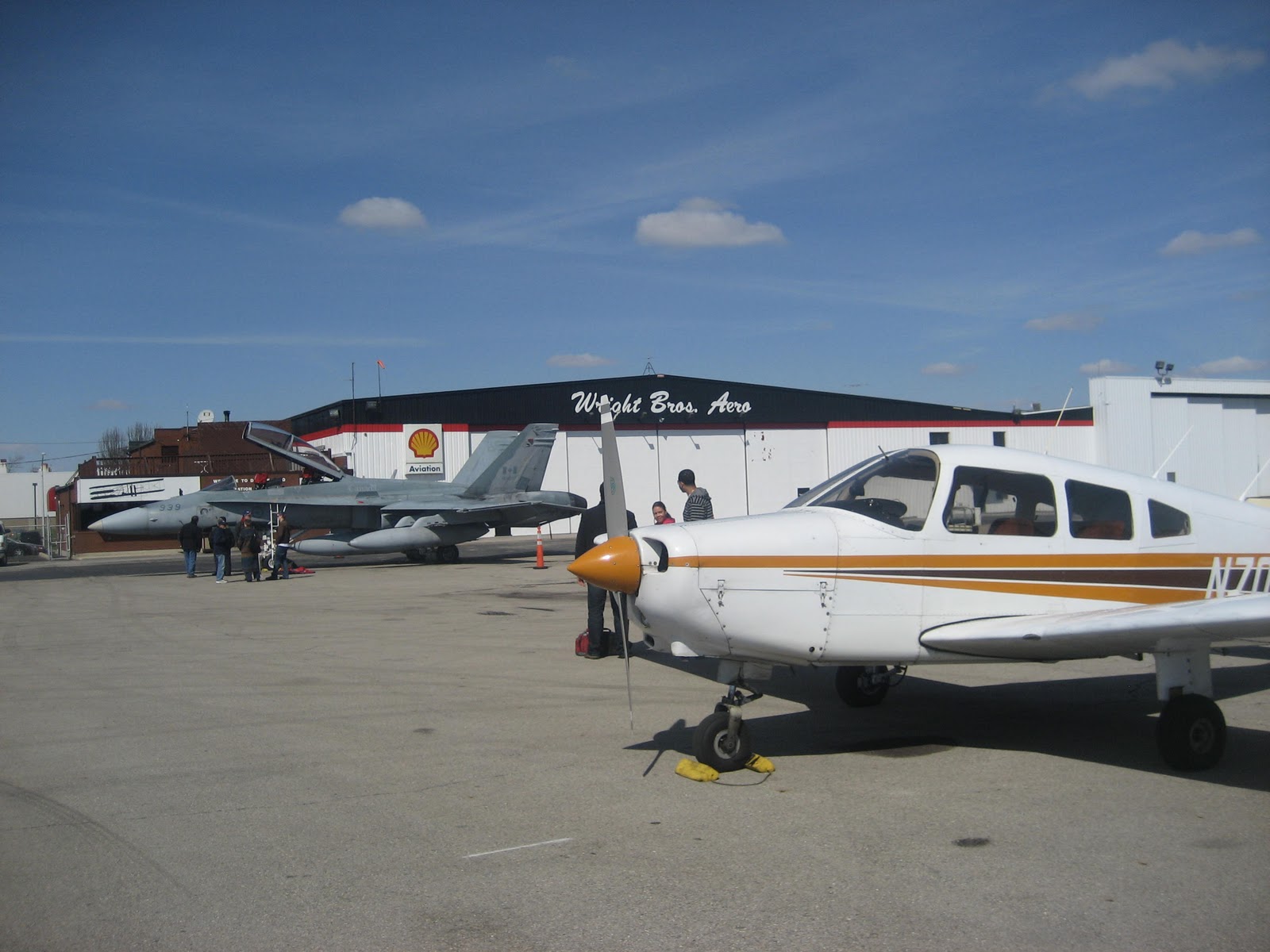
When we pulled up to the General Aviation Ramp I was greated not only by the friendly folks at Wright Bro's Flyers, but a Canadian Royal Air force F18. Apparently he had some mechanical issues with his fly by wire flight computers. So he had to detour until the Airforce could send a mechanic to fix the problem. He was enroute to an airshow. I felt bad for him because he had been there for a couple of days.


 We ate dinner then went to the gun range to shoot a few rounds off. Then back up into the sky!!! What a fun weekend.....
Then on Sunday had an excellent day at church. Then afterwards took my wife to Dayton International - DAY to meet some friends for dinner. I fought a headwind @ 5,500 feet going there and got vectored a bit so it took about an hour 20 minutes to get there. But coming back it only took about 50 minutes @ 6,500 feet. I flew my wife over our house on the way home and we saw the "mega house" off Michigan by Butler's campus.
When we pulled up to the General Aviation Ramp I was greated not only by the friendly folks at Wright Bro's Flyers, but a Canadian Royal Air force F18. Apparently he had some mechanical issues with his fly by wire flight computers. So he had to detour until the Airforce could send a mechanic to fix the problem. He was enroute to an airshow. I felt bad for him because he had been there for a couple of days.


Saturday, March 19, 2011
iPad 2 Full Review
Today I flew my iPad down to Clermont County, Ohio (I69) and visited Sporty's Pilot Shop. They not only have free lunch every Saturday, but you get to meet cool people. This was a fun flight because I got to navigate Class Bravo Airspace and travel quite far.
I got the Wifi Only iPad for a couple of reason. 1) I don't need 3G internet 2) 90% of the places I go have free wifi access. The negative of the wifi only iPad is that it doesn't have a built in GPS. However I've heard from pilot's that the built in GPS on the iPad is not a real GPS. It's an A-GPS which means assisted. It uses the cellular towers to triangulate and help get a fix faster. I guess because of that the GPS is only pretty accurate during straight and level flight. All of this is to say is why I wanted to get an external bluetooth gps module any, thus got the wifi only to save money.
I simple connect my bluetooth gps to my iPad and throw the GPS receiver either in the window or leave it on the passenger seat. I compared the readings on the app to my Garmin 196 and it was virtually identical.
For the modern pilot, I think an iPad is almost a must have accessory. It makes the cockpit much more clean, paper free, and allows the pilot to focus on other things instead like watching out for traffic. I now wonder how did I fly before I had this thing! Also pilots love redundancy. I have my Garmin 196, my iPad, VOR's, and my backup paper charts. With all these options....if I get lost, it's my own fault :)
Happy Flying!!
I got the Wifi Only iPad for a couple of reason. 1) I don't need 3G internet 2) 90% of the places I go have free wifi access. The negative of the wifi only iPad is that it doesn't have a built in GPS. However I've heard from pilot's that the built in GPS on the iPad is not a real GPS. It's an A-GPS which means assisted. It uses the cellular towers to triangulate and help get a fix faster. I guess because of that the GPS is only pretty accurate during straight and level flight. All of this is to say is why I wanted to get an external bluetooth gps module any, thus got the wifi only to save money.
I simple connect my bluetooth gps to my iPad and throw the GPS receiver either in the window or leave it on the passenger seat. I compared the readings on the app to my Garmin 196 and it was virtually identical.
For the modern pilot, I think an iPad is almost a must have accessory. It makes the cockpit much more clean, paper free, and allows the pilot to focus on other things instead like watching out for traffic. I now wonder how did I fly before I had this thing! Also pilots love redundancy. I have my Garmin 196, my iPad, VOR's, and my backup paper charts. With all these options....if I get lost, it's my own fault :)
Happy Flying!!
Friday, March 18, 2011
iPad and Weather
Today after work I wanted to fly to DAY for a party. However a small system was moving through. The ceiling was high and the visibility was good. However being a conservative pilot I aired on caution.
I checked the weather during at planned departure time. It turns out that the system moved through and I could have flown safely!
I guess it goes to the old adage "it's better to be on the ground and wish you were up there than to be up there and wish you were on the ground.
Not all is lost though. This gives me time to play with my new toy. I just became the newest pilot to adopt the iPad. I gave it a test spin on Thursday. It's awesome. This device will revolutionize the aviation industry. Delta, net jets, and a few other airlines have already adopted it or plan to adopt it.
The app I use is Foreflight. It's pretty cool. I will attach some screen shots. When I'm in the plane, the app can connect to my gps so it'll point specifically on the Sectional Chart where I am at! Awesome...


I checked the weather during at planned departure time. It turns out that the system moved through and I could have flown safely!
I guess it goes to the old adage "it's better to be on the ground and wish you were up there than to be up there and wish you were on the ground.
Not all is lost though. This gives me time to play with my new toy. I just became the newest pilot to adopt the iPad. I gave it a test spin on Thursday. It's awesome. This device will revolutionize the aviation industry. Delta, net jets, and a few other airlines have already adopted it or plan to adopt it.
The app I use is Foreflight. It's pretty cool. I will attach some screen shots. When I'm in the plane, the app can connect to my gps so it'll point specifically on the Sectional Chart where I am at! Awesome...


Wednesday, March 2, 2011
Connersville, Indiana (CEV)
Yesterday and today are the first days the weather has been VFR in quite a while. So I took advantage. I flew to CEV after work. The weather was great! I even caught a nice sunset yesterday. As I said before, the pictures don't do these views justice at all. Sometimes I wish I didn't have to look out for traffic and could just stare at the beauty.....These pictures were taken 3/1 and 3/2 at about ol i guess 3,500ft-4,000ft MSL as I climbed up to my cruising altitude of 5,500ft MSL.


This just looked like a cool shot so I took the picture. You can see my car clean and salt free for once!!


This just looked like a cool shot so I took the picture. You can see my car clean and salt free for once!!
Wednesday, December 29, 2010
FTY to LGC (Fulton County Brown Field - LaGrange Callaway Airport
I came home to Atlanta for the Christmas/New Year Holiday. As I'm sure you know I could not pass up this opportunity to fly with the nice warm weather down here. I got checked out in a Cessna 172 and rented it to fly down to LaGrange.


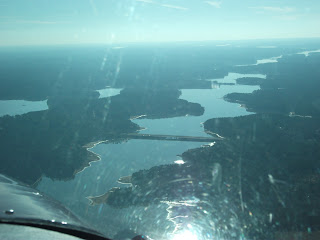


 The 172 is a high wing plane so it's pretty different to fly. It was a fun experience. The visibility was great. I couldn't have picked a better day to fly. Check out a few of the best shots my friend took above. The lakes in the picture are part of west point lake along the Georgia/Alabama state lines.


Wednesday, December 15, 2010
Christmas lights!
Last night I braved the 5degree weather and went flying. It was amazing!! The plane performed like a jet. I climbed to pattern altittude before I was on my downwind leg. On a hot summer day I could spend the entire pattern climbing and land before I reach 1000ft agl.
The coolest part of last nights flight was seeing all of the ground covered in snow and the Christmas lights. I wish I had a camera that could show you guys the pictures. Now I see why pilots say cold weather flying is great. No turbulence no bumps.
The coolest part of last nights flight was seeing all of the ground covered in snow and the Christmas lights. I wish I had a camera that could show you guys the pictures. Now I see why pilots say cold weather flying is great. No turbulence no bumps.
Monday, December 13, 2010
Winter Blues
The midwest has gotten dumped with snow. Consequently I haven't flown. Not because the runway is full of snow because it's plowed. But because its COLD outside. I'll try to get out to airport and take some pictures. Flying with snow on the ground is a lot different than when you can see the ground. The landmarks and references are all covered in snow. The lakes that you use for references are now frozen over and look like fields....
I'd better be good at using my radio navigational devices.
I'd better be good at using my radio navigational devices.
Monday, November 29, 2010
Official License
Today I received my official license in the mail. It only took about 4 weeks surprisingly. It's pretty cool to actually hold it in my hand. It feels kind of like when you graduate from college. You know you have a degree but it's not the same until you are physically holding it in your hands.
For some fun facts....
According to the AOPA Jan. 12, 07 newsletter.
84,866 student pilots
242 recreational pilots
939 sport pilots
236,148 private pilots
130,234 commercial pilots
144,681 airline transport pilots
Due to the economy these numbers have been declining. I wouldn't be surprised if the numbers are now 10% lower!
To get my commercial I have to have 250hrs**. To get my ATP I have to have 1,500hrs**! I've got a long way to go. One step at a time.
**Obviously it's more than just the hours but that's just a simplified reference point.
For some fun facts....
According to the AOPA Jan. 12, 07 newsletter.
84,866 student pilots
242 recreational pilots
939 sport pilots
236,148 private pilots
130,234 commercial pilots
144,681 airline transport pilots
Due to the economy these numbers have been declining. I wouldn't be surprised if the numbers are now 10% lower!
To get my commercial I have to have 250hrs**. To get my ATP I have to have 1,500hrs**! I've got a long way to go. One step at a time.
**Obviously it's more than just the hours but that's just a simplified reference point.
Subscribe to:
Posts (Atom)